


 Reply With Quote
Hi, i think they do take nerite. Have found an empty nerite shell in my tank after adding these guys. However my horned nerite is the same size as them so its not surprising.Originally Posted by illumnae







I had about 15 in a tank with three large apple snails. Two died but I am not sure whether the Clea helena was chewing on the foot of the apple snails.
Hi, i think they do take nerite. Have found an empty nerite shell in my tank after adding these guys. However my horned nerite is the same size as them so its not surprising.
Hello people,
i like to share my expriences with this snail after i read kira76 witnessed the snail wrapping itself around a sulawesi shrimp. Sad to say its true, this snail eats sulawesi shrimps and i believe they have the capability to prey on the shrimps and finally consuming them.
i myself exprienced it when i left my sulawesi shrimps in a breeder trap with three of these snails to do a head count of my harelequin in the tank. My Harlequin were healthy when placed inside the breeder trap and within 10 minutes when i was done with my headcount and reshuffle of the tank layout i saw two of the snails wraping around one shrimp devouring it and a single snail devouring a second piece by itself. i actually tried to remove the shrimp from the snail with my fingers but the shrimp was already motionless.
i quickly removed the snails into a small tub and watching them consume the dead shrimps rapidly. Leaving behind only some of the shell, which i actually found quite a few of these bits and pieces of shell in my tank under my rock and driftwood. It is quite obvious the shells were leftovers by the snails after they made a meal off my harelequins because the shells were not much of a complete shell structure but rather the head or small body parts fragment shells plates.
I hope you guys can learn from my mistake and keep these snails away from your sulawesi shrimps. But still im not too sure of wherther they be able to kill other shrimps cause in my observations, my harelequins don't run away from these snails i actually saw one piece standing right on top of these snails. Another observations is my harelequin isn't as active as other shrimps and they tend to stand or move just a little the whole day. Which i think makes themsleves to be quite a easy prey.
here are some pictures of my harelequins which i have already sold. I do miss them a little sometimes.
http://www.flickr.com/photos/2463619...7605748154123/
Cheers,
weiquan
Last edited by weiquan; 23rd Jun 2008 at 22:13. Reason: update links to pictures
Fish Room Inventory
Plecos : L333, L400, L144, Corydoras black venezuela, Royal whiptail

 Never create what you can't control


Pardon me for saying this, but there are too many variables and uncertainties to these observations. In my opinion, these Sulawesi shrimps are way way way too fragile to conclude anything. Sorry, I am not convinced.
That said, as I have mentioned this before, if unsure, then simply don't keep shrimps and A. helena together.
i've put one of these in a tank with my sakuras which have been living happily in the tank for the past few weeks. doubt they'll die of natural causes so we shall see.
i also have a nerite in there, which c328 auntie told me they feast happily on but the nerite is easily 2-3x the size of this snail. so hopefully A. helena will pick on snails its own size and smaller
Quixotic,
its nice to share your views to my observation and belief
and i do share the same sentiment on "if unsure, then simply don't keep shrimps and A. helena together"
Cheers dude.
Last edited by weiquan; 24th Jun 2008 at 13:54. Reason: spelling mistake
Fish Room Inventory
Plecos : L333, L400, L144, Corydoras black venezuela, Royal whiptail
 Never get sick of fishes.. They are addictive..

Just to share my experiences as well.. I have no problems with these killer snail in my tanks with my sakuras.. Sometimes I do noticed that when a shrimp died.. The snail will feed on them.. No doubts they are mainly carnivores as I always see them moving very fast and feed on the frozen brine shrimp.. But never really see them in action of killing my shrimps.. Another thing.. They don't even kill my other snails in the tank.. All my horns, zebra snails are still alive.. No empty shells lying around.. But perhaps it is because I only keep 4 - 5 of them in the tank..
Searching For - C.Goldline and C. Black ven
So far it's been a success in my 2ft tank. I hardly see MTS anymore. I'm sure the MTS are still around but they've stopped coming out to feed.The sand is littered with empty shells. I still see the Helena snail occasionally but it keeps burrowed mostly. My other lifestock - Malayan shrimp,C.pygmaeus, ember tetra, galaxy and kuhli loach are unharmed.I think one is enough for a small tank. I am going to used it on another tank with only corys. I think it will disagree with Botia or Nemachellius type loaches as they are known to harrass all types of snails.
Mine have eaten all the adult ramshorn snails in the tank, luckily there are many eggs and aby snails. MTS are eaten, but not as quickly. Occasionally they will fight with the shrimps for food I drop in, so they aren't totally dedicated snail eaters.I have never noticed it attacking a shrimp.
Never create what you can't control
Read an article by Dr. Neale Monks in Practical Fishkeeping magazine on them, thought I'd share them here...
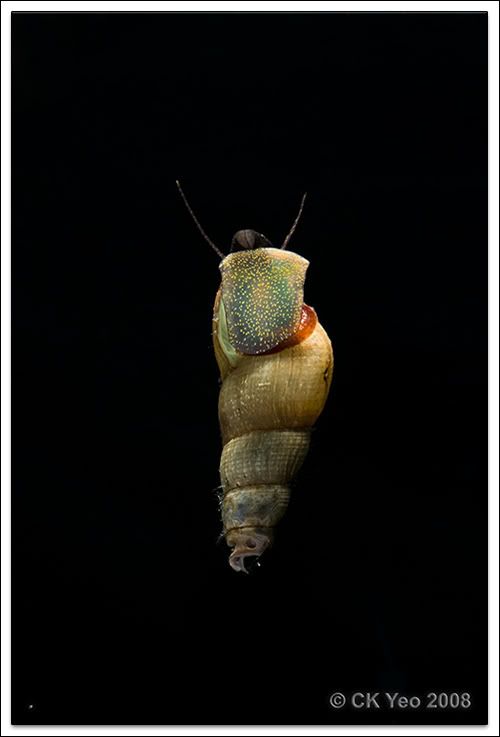
Anentome (or Clea) helena is a member of the whelk[1] family, found in muddy and sandy streams in South East Asia.
It is a predator that feeds primarily on other snails. It also eats carrion (i.e. carcass of a dead animal) and other small invertebrates (potentially including baby cherry shrimps). This may explain the dent in shrimp population like what some of you have experienced.
Fish eggs and fry are likely at risk too. However, it has no interest in adult shrimp, algae or plants. Therefore, your adult dwarf shrimps (cherry shrimp, CRS and the likes) should be safe.
It is a burrowing snail, likes to dig into sand when resting. It only seems to kill one snail a day, so do not expect them to rid of your snail problems any sooner, unless you have an army of A. helena.
[1] See Wikipedia, Whelk, http://en.wikipedia.org/wiki/Whelk (as of Jul. 23, 2008, 17:01 GMT).
Yes. Mine only one snail is burrowing all the time I couldnt find her. However I notice a baby snail these few day... I heard this type of snail need male and female to preproduce?
Last edited by catohcat; 24th Jul 2008 at 12:06.
Never create what you can't control
Supposedly yes. Is it positive that they are A. helena baby snails?
The babies look something like this, http://www.allesumdieschneck.de/html...me_helena.html
I have a single A. helena in my cherry shrimp tank which is infested with baby pouch snails and baby ramshorn snails. So far it has only attacked the baby pouch snails and it is very efficient at reducing their population. But so far I have yet to see it attack the baby ramshorns...could it be that the size or shape of the shell that prevents it from going after the ramshorns?
Yours Truly, Avan
I went into the woods because I wanted to live deliberately. I wanted to live deep and suck out all the marrow of life... to put to rout all that was not life; and not, when I came to die, discover that I had not lived.
~ Henry David Thoreau
 Jinxed fishy photographer
[Specialist]
Jinxed fishy photographer
[Specialist]
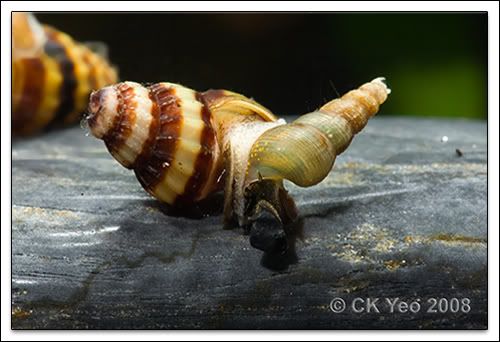
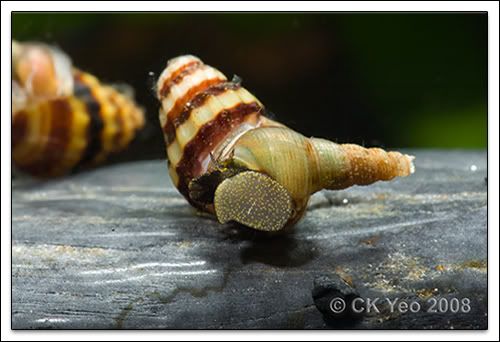
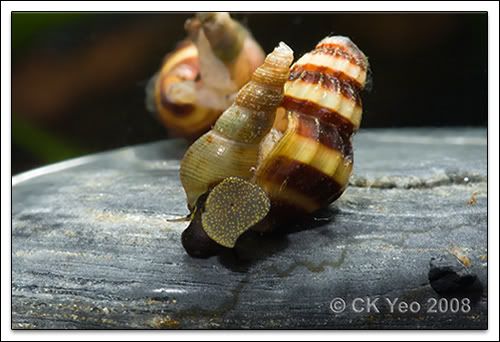
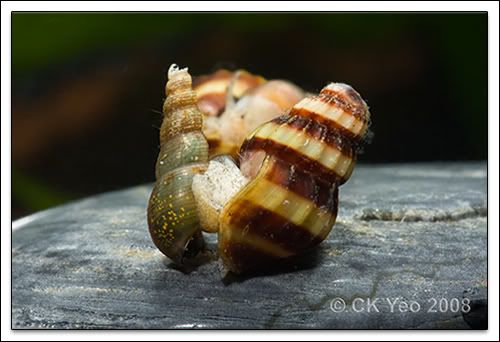
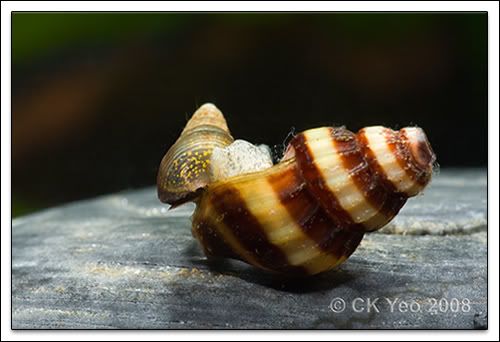
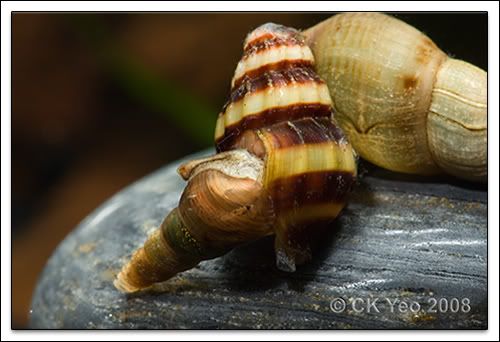
Well, I can only confirm that it eats malayan trumpet snails. Was starring at it for a long time. It is like watching a slow motion African safari scene. Like what the others noticed, it does not have a great impact on the snail population immediately and they eat the uneaten pellets for the fishes. There seems to be a certain size threshold of their victim.
*Wanted*
The Victim
AH: *gotcha*
MTS: Huh?
MTS: OMG! Run!
AH: You are not getting away! Muahaha!
AH: Yum.
It sticks its head into the MTS and extend a probe between the head (not the one they dangle around) to suck up everything. Whole process took quite a while. (giant MTS behind)
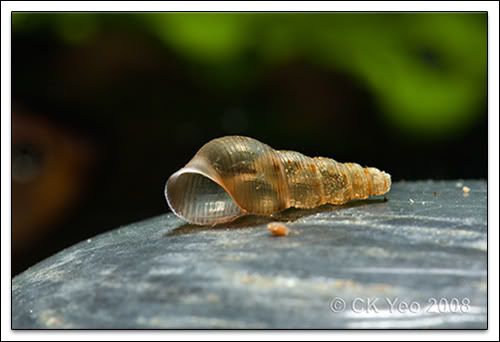
What's left of the murder scene.
ck
Please pardon the slight under exposure of the pics.
Yes, confirm. The baby looks exactly as the adult Helena, with the little trunk. The size is about 3mm. He runs quite fast and also frequently burrowing himself like his mother/father. I have been keeping 1 adult Helena for the past 3 months only. Now i'm thinking of the way to dig them out since they may posea thread to my babay shrimps.
Never create what you can't control
CK, great series of photographs! Poor MTS...
It is quite certain that they are gonochoristic and lay eggs. So I can only think that she could have been inseminated internally by a male during copulation, just prior to being brought back into your tank.
Jinxed fishy photographer
[Specialist]
haha. Thanks. Them moving in slow motion helped a lot.
erm. So how to tell the male from the female?
ck
Superb shots there bro.
By the way, have you caught them killing snails bigger than their size before?
Got no luck with this helena snails. Didn't see them eating those common snails in my tank which keep on multiplying. Frustrated and I put in two drawf puffers which within a week, whack all those snails in the tank.
Did your dwarf puffers feast on your A. helena?
 Posting Permissions






Bookmarks