


 Reply With Quote
Oh my. Sorry to hijack the thread too! Got caught up with so many questions.Originally Posted by milk_vanilla

Love the scape! Looking forward to any updates!
Sent from my GT-I9100 using Tapatalk 2





Bps is a tricky measurement, our tank miles might vary.
If you use ph/kh chart, aim as high as you can. Like 50 ppm or higher. It may not accurate but expert says it won't beyond than the table it could happen be less instead.
If you use drop checker, make it into lime green, or yellow best.
No fauna is the best during transition. You could boost whatever you like and convenient.
My kh is 3-4, ph is 6.2 - 6.3 during co2 period. Or else 6.7 - 6.8
Sorry urban, not mean to hijack your tree scape tank. It's good tank, i mean it.
Sent using Tapatalk 2
Oh my. Sorry to hijack the thread too! Got caught up with so many questions.
Love the scape! Looking forward to any updates!
Sent from my GT-I9100 using Tapatalk 2
Hi, may i know where did you get your tank?
any recommendation for the tanks.
Hi, may i know where did you get your tank?
any recommendation for the tanks.
 Re: 32 litre "Tree Scape" Tank!
No probs... all the sharing of information is very helpful, i'm also learning too.
Here are some of my thoughts on growing HC so far...
I guess one of the main contributing factors in my HC carpet growing submerged without requiring additional Co2 injection is because i did dry start method (DSM) on them before flooding the tank.
The DSM process allowed the HC to establish their roots and spread well, so when the tank is flooded, even though the HC browned abit during the emersed to submerged transition period (during the first 1-2 weeks after flooding), there was still plenty of plant mass to recover and progressively adapt to the new underwater conditions and reduced Co2 levels.
In addition, i also made sure the HC is the dominant plant in the tank, without any competition from other demanding plants... HC is kinda like the "runt" of a planted tank, they are so short and low on the substrate that they are usually the last to receive light, most other plants grow taller and get more light to photosynthesize and hence grab all the nutrients and Co2 first, leaving the HC with only leftovers.
I think most of the time when HC fails to grow in tanks is because they are usually grown emersed at the plant farms (the HC mats at LFS are usually in plastic cartons or bags, but not submerged), then they are bought by aquarists and planted directly underwater. The newly planted HC have to go through the initial transition period with very weak plant mass and no established root system, so that is like multiple shocks and stress to the plants which tends to make it much tougher for them to recover and adapt properly (especially in new tanks with wildly fluctuating parameters).
Btw... i would consider HC more as an emersed plant as i've seen them flourishing in outdoor carpet grass gardens (where they creep over the carpet grass like weeds). But like with many plants that aquascapers use, they are able to adapt to both emersed and submerged conditions.
Re: 32 litre "Tree Scape" Tank!
I got my tanks from Green Chapter. East Ocean also sells those tanks too.
They are usually labelled as "crystal" or "opti-clear/opti-white"... but all seem to be from the same manufacturer called "Yi Ding" (the name is on QC stickers at the bottom of each tank).
You can easily tell them apart from normal glass tanks by looking at the edges and joint sections, you'll see the glass is much clearer and more whitish (due to the low iron high clarity glass), rather than greenish like in normal tanks.
That is one awesome tank, i love the clarity of the tank!
I do have a usual question, do you soak your bogwood before placing it into the tank.
Based on my experience, even i soak a driftwood or bogwood in water for about 1 month, it still leaks tannins.
Re: 32 litre "Tree Scape" Tank!
Thanks!
Yeah, i scrubbed the bogwood with a brush, boiled it for 2-3 hours (alot of tannins were released during boiling, the water became dark brown) and then soaked it in a bucket for around 3 weeks (changing the bucket water every few days when it turned tea colour). Only when the bucket water stayed clear, then i transferred the bogwood to my tank.
I guess it just takes time.
Just read this insightful thread. Wonder if tank without co2 supplement is still achievable with introduction of stem plants? Will the growth be slowed down or impaired?
Co2 supplementation is basically one of the main components to artificially accelerate plant growth using technology... in nature, Co2, light and nutrients are all limited resources and plants grow according to whats available to them in ponds and lakes (the more aggressive plants grow faster, the less aggressive ones grow slower), so in my view all plants should be able to grow without additional Co2 injection or supplementation, they just grow at nature's pace.
It'll be really odd if a plant constantly needs high tech Co2 injection just to grow... then how does it survive in the wild in the first place?
In a non-Co2 injected tank, the main factor we can control is lighting, if there is too much lighting but not enough Co2, plants cannot photosynthesize effectively, so its a matter of adjusting the lighting intensity or duration shorter to achieve an equilibrium. As a result, the plants also require less nutrients to convert into energy so additional fertilization usually isn't required (in such tanks, the fauna supplies nutrients though the conversion of the food they consume and their waste, the goal is also to achieve the right balance of flora and fauna so that its totally self-sustaining).
So whether one goes for the high-tech accelerated route or low-tech natural route, i guess it all depends on whether you want to have a lush scape within 1 month... or have the patience to let it develop over 5-6 months instead.
Last edited by Urban Aquaria; 22nd Feb 2013 at 22:00.
I like this perspective
Get the Equilibrium within yourown is the hardest, time consuming and fascinating experience.
Yeah, it definitely requires additional planning to setup everything in balance, both the flora and fauna have to be thought out carefully and introduced slowly to complement each other (cannot anyhow mix and match or rush it)... there is alot more planning and concessions required than compared to high-tech tanks, where one can just buy all the equipment, stuff the tank full of different competing aggressive plants, crank up the Co2 injection, dump in lots of fertilizers and chemicals, then blast the plants with high lights the whole day.
I guess the practices are similar to growing vegetables in mass production high tech farm vs 100% organic farm.
Re: 32 litre "Tree Scape" Tank!
Its been another 4 weeks since and time for an update!
Still no Co2 injection, no Excel, no fertilizers added... and the Hemianthus Callitrichoides (HC) carpet is still growing steadily.
Although i actually do have Co2 injection equipment, chemicals and fertilizers available to use, i'm now very keen to see how this tank progresses without the help of those items. It will be an on-going experiment in using a low-tech/low-maintenance natural approach to plant growth.
I have also added in a group of Danio Margaritatus (aka Celestial Pearl Danio) and Danio Erythromicron (aka Emerald Dwarf Danio) as the new resident fauna, both are very similar in size, shape, behavior and habits, often banding together in small "hunting" packs and patrolling the mid-bottom levels of the tank.
In addition, i spotted many small shrimplets in the tank recently, so to prevent them from getting sucked into the canister filter, i've also had to install a stainless steel mesh guard on the filter intake too.
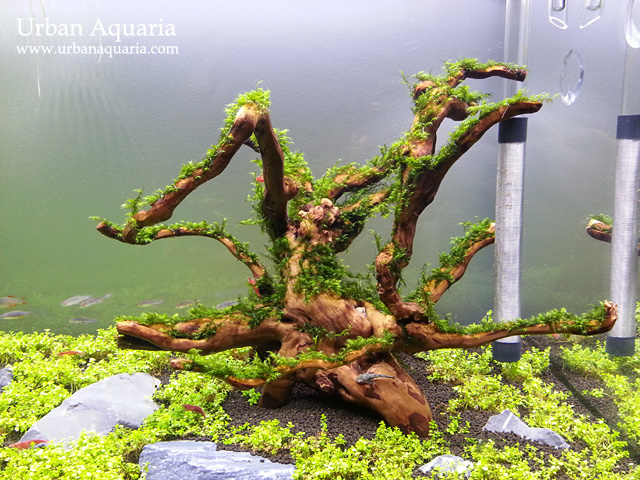
Here is a photo of the tank at Week 6:
Notice that the HC carpet on the left side of the tank looks much brighter and more lush than those on the right side?
My guess is that the bogwood piece is perhaps overshadowing that area, so the growth is slower there. It could also be due to the water current being better at the left side too (based on the flow direction of the lily pipe output).
This probably resembles the effect of large trees in nature, where the areas under them usually have less plant growth, due to the tree canopy blocking out sunlight and drawing in more nutrients.
The biggest surprise for me is the growth of the Fissidens Fontanus on the bogwood tree structure, there is definitely a very noticeable difference in the space of 4 weeks... the fissidens cling to the wood very securely on their own after just a few weeks and alot of fresh new growth can be seen sprouting out from the sides of the trunk and branches.
I was expecting the fissidens to grow very slowly, but it turns out that they are actually growing much faster than i expected.
Looks like i don't have to wait too long for a nice lush fissiden tree after all!
Last edited by Urban Aquaria; 4th Mar 2013 at 22:32.
It might be your fissiden closer to the light. Good stuff to learn for busy workaholic folks.
Re: 32 litre "Tree Scape" Tank!
I agree... proximity to light does make a huge difference!
Your non CO2 method works only when there is total darkness during the "blackout" period or do you think room lights on during "blackout" period works too?
Inspired by AmanoLimited by Yusof Ishak
Re: 32 litre "Tree Scape" Tank!
For my case, when the lights are off during the mid-day "siesta" period, there is usually still some light in the room... either from ceiling lights (if someone is using the room) or some diffused light coming in through the window day curtains, so its not totally dark.
Btw, one of the other reasons why i use the 2 shift lighting schedule is also to enable the lights to still be on for viewing the tank when i return home from work.
Hey bro, been keeping messy tanks for a while and recently decided to go into scaped tanks. Wonderful read and very inspiring!
Re: 32 litre "Tree Scape" Tank!
Thanks!
Interestingly, i'm thinking of going the other direction with another new tank i'm starting up, might be considering to do a jungle theme with lots of plants... only thing i'm worried about is all the fishes and shrimps disappear into the dense plant mass and don't want to come out.
I like the theory of allowing the plants to replenish CO2 in the tank before it starts on another photosynthesis cycle.
I guess for a non-CO2 tank CO2 is the limiting factor and it is important to control it well by playing around with the light intensity and duration. I am just curious if we were to add a CO2 checker to the tank. Will it helps us to better determine when to turn on and turn off the lights based on the colour indication?
I noted that you are using a 4 hrs on, 4 hrs off and then 4 hrs on cycle. Will it differ from tank to tank as the plants mass are different?
 Posting Permissions




Bookmarks