


 Reply With Quote
hey did you catch this yourself? can't find the name in FishBase, do you mean Stigmatogobius poicilosoma ?








Would mickthefishgod care to shed some light on this? I've managed to tell males from females but they don't seem to be mating... despite water conditions being close to their natural environment. Will post male/female photos later. Gotta start heading for the photography workshopwee!

Last edited by XnSdVd; 18th Mar 2006 at 21:43.
hey did you catch this yourself? can't find the name in FishBase, do you mean Stigmatogobius poicilosoma ?
why I don't do garden hybrids and aquarium strains: natural species is a history of Nature, while hybrids are just the whims of Man.
hexazona · crumenatum · Galleria Botanica
awaits for ur pic...cheers
Originally Posted by hwchoy
One can never trust that stupid book from the science centre... or my memoryI refer to Stigmatogobius poecilosoma in the book. Has the species name been changed? And yes they're of the native strain but not caught by me. Though i used to catch then when I was younger. Seem to have disappeared from neighbourhood waterways though. Sad..


to be honest, ive only bred two kinds of goby mogurnda mogurnda and tateurndina ocellicauda, one is a cave spawner the other spawns on vertical walls, i should imagine yours is a cave spawner will look into it for you.
cheers mick
Interesting that you should mention vertical walls... I used to catch them by scraping my net along the wall of the pond.
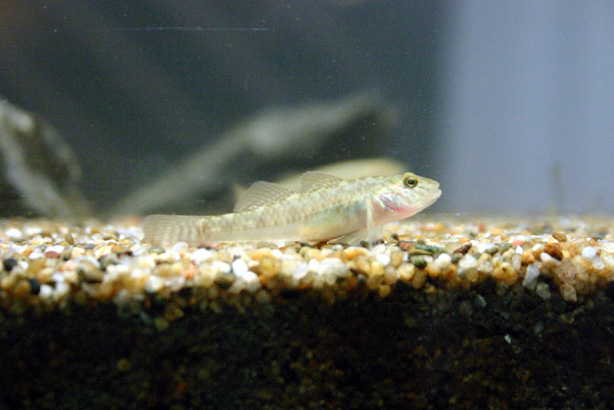
Female:
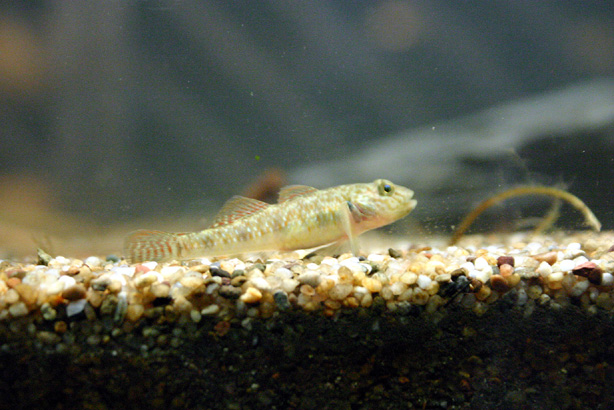
Male:
I'm working under the asumption that males are almost always more colourful than females. That and note the black marking behind the gills. It's only present in individuals that have red markings on the body and fins.
i'd say your spot on with the sexes, same as choy ive searched the web and can't find them but they know the name why not try raffles in SG they must have some info there, will keep searching and asking at the fish clubs.
mick
that new science centre goby book? or the old freshwater fish book? just to let you know the authors does read this forum
anyway, it is Stigmatogobius so you are satu misspellingand to be cautious I would check the specific epithet since FB does make mistakes too.
back to your fish, I think you or vincent gave me this fish before. it may not be poicilosoma but a foreign species that has replaced the native one. However this has only being worked upon so let's see what Helen Larson has to say.
why I don't do garden hybrids and aquarium strains: natural species is a history of Nature, while hybrids are just the whims of Man.
hexazona · crumenatum · Galleria Botanica

 Never create what you can't control


An update on the common pond goby, which was thought to be Stigmatogobius poecilosoma/poicilosoma).
Helen Larson has published the findings in the latest Raffles Bulletin of Zoology. Refer to the paper, Helen K. Larson, Zeehan Jaafar and Kelvin K. P. Lim, 2008. An annotated checklist of the gobioid fishes of Singapore. RBZ 56 (1): 135-155.
So whatever that has been published in the old freshwater fish book is just a tentative identification. The following species are the actual common pond gobies of Singapore, but they are thought to be extinct.Alfred (1966), in his monograph of the freshwater fishes of Singapore, recorded a single species of goby which he referred to as Sigmatogobious poicilosoma. Lim & Ng (1990) also treated the common goby in Singapore under this name, but stated that it was only a tentative identification. An examination of Alfred's material showed that he had misidentified the freshwater gobies. The common pond gobies of Singapore actually included two species, Pseudogobiopsis oligactis and Pseudogobiopsis siamensis. The specimens illustrated in Lim & Ng (1990) as Stigmatogobious poicilosoma are an introduced species of Rhinogobius.
Pseudogobiopsis oligactis (Bleeker)
...
Remarks: This species appears to have become extinct in Singapore, with the only known specimens having been collected in 1959. Despite recent surveys of most habitats on the island by resident biologists, P. oligactis has not been found since. Munro's (1990) diagrammatic Fig. 5 shows a species of Pseudogobiopsis; however, his discussion could also refer to Rhinogobius giurinus.The following species are also listed as possibly misidentified as Stigmatogobious poicilosoma.Pseudogobiopsis siamensis (Fowler)
...
Remarks: Tweedie (1940) refers to paratypes of Vaimosa singapurensis Herre lodged in the Raffles Museum. This was possibly a museum name for Vaimosa jurongensis Herre. The species was thought to be locally extinct (see Ng & Lim, 1996: 113) until three specimens (ZRC 50271) were collected in March 2005.
Pseudogobius javanicus (Bleeker)
...
Remarks: This is a widespread species being revised by Larson (in prep.). There may be another species confused with P. javanicus.And lastly, (if I understood correctly) the pictures in the book and the website, http://habitatnews.nus.edu.sg/guideb...h/text/236.htm could actually be Rhinogobius giurinus.Pseudogobius melanostictus (Day)
...
Remarks: This species is being revised by Larson (in prep.). Pseudogobius melanostictus may not be the correct name to apply to the Singapore population.
(Edit: Thread title changed to avoid unnecessary confusion.)Rhinogobius giurinus (Rutter)
...
Remarks: This introduced species from East Asia may be partly responsible for the decline and apparent disappearance of Pseudogobiopsis species in Singapore.
Last edited by Quixotic; 19th Apr 2008 at 01:01. Reason: Spelling
 Posting Permissions



Bookmarks