


 Reply With Quote
Looks like more species are coming. So only the tail and the rostrum are blue while the rest are translucent? Can see the whole setup? Thanks.





 Never create what you can't control




Picked up a couple of these shrimp in the recent Sulawesi shipment.
Their shape reminds me of Caridina gracilirostris, with their long rostrum but the colour is blue!
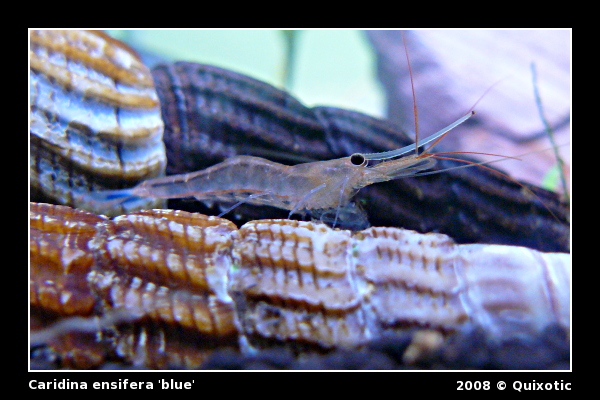

Looks like more species are coming. So only the tail and the rostrum are blue while the rest are translucent? Can see the whole setup? Thanks.
God will make a way, where there seems to be no way
interesting shrimp, is the price high ?
usually those supplier likes to jack up a high price

Saw these shrimps over at C328 few days ago,didn't look that blueish to me though...But there is definitely no mistake with the distinct shape!You can find them in the betta racks near the cashier over at C328.They have 2tanks with "Sulawesi Shrimps" written with black marker on them,you won't miss it!Do check them out tomorrow and update us on pricing if you can.Originally Posted by bbpippen


probably blue refers to the horn. I didnt take note of the price when i was there 3 weeks back, but alot of people were crowding near the mini showcases of the shrimps.
Never create what you can't control
Wilson, just a temporary tank lah, nothing worth mentioning. Tore down one of my semi-planted tank for other fishes, and simplified it.
Tank is slightly less than 30 cm, using a HOB filter suitable for 45 to 60 cm tanks (I like to overfilter), didn't change the GeX soil but managed to buffer the pH to 7.8 by filling up one of the large chambers in the HOB with coral chips, removed most plants but left a few small clumps of moss and several large stones, and with aeration from an air pump.
As they are Sulawesi shrimp afterall, the price is in the same range as with the rest of the Sulawesi shrimp.
Considering that these shrimp are wild, endemic to Sulawesi only, and very new to the hobby, without much information on the husbandry, little information on their sustainability in the natural habitat, I am of the opinion that the price is considered rather "affordable".
However, I think (and I hope) that mass breeding of the Sulawesi shrimp is in place and ease the demands of the wild stock. Price would certainly be much much affordable by then.
Not really, the blue refers primarily to the colour of the tail. FYI, there is a different form of C. ensifera which looks the same but with red in the tail. Hence, the 'blue' and 'red' tags to differentiate the variant.
However, there are interesting notes about these two form which I have mentioned briefly in a previous post. I'll post some information of these later.
 Posting Permissions


Bookmarks