Advertisements
Aquatic Avenue Banner Tropica Shop Banner Fishy Business Banner
Results 1 to 5 of 5

Thread: Simpsonichtys chacoensis; the incubate period

  1. #1
    Join Date
    Jul 2004
    Location
    Norway
    Posts
    116
    Feedback Score
    0

    Simpsonichtys chacoensis; the incubate period

    Advertisements
    Fresh n Marine aQuarium Banner

    Advertise here

    Advertise here
    Hello all

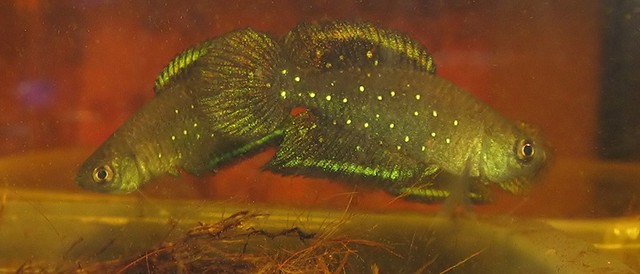
    Just one question, I have 3 pair with s. chacoensis, and they are playing all day long I have red several places that the incubat period is 6 months. do anyone of you have any experience with this lovely species?

    If you want to see som picture I took yesterday you find it at this link (thread from 192 -196)

    http://www.nettakvariet.no/forum/sho...&page=13&pp=15
    Regards
    Svein

  2. #2
    Join Date
    Jul 2002
    Location
    Bukit Batok
    Posts
    8,790
    Feedback Score
    0
    Images
    9
    Country
    Singapore
    Svein, I don't have personal experience with this species but since it comes from the Gran Chaco region of Paraguay, I believe the incubation period would be much longer than usual. I happen to have an article regarding some killifish collections done in Paraguay and written by Daniel Fromm. Unfortunately that article did not contain details on incubation periods apart from stating the size of the eggs.

    From a rough incubation guide published on the DKG-Cynolebias site, the information states the following data:

    24degC - 3 months
    27degC - 2 months

    Again, this is based on the DKG data. It would be advisable to check on the eggs for development on a weekly basis. :wink:
    Fish.. Simply Irresistable
    Back to Killies... slowly.

  3. #3
    Join Date
    Jul 2004
    Location
    Norway
    Posts
    116
    Feedback Score
    0
    Thanks a lot, and i think it`s time to start studying eggs, I haven`t done this, but I see this is important.
    regards
    Svein

  4. #4
    Join Date
    Jul 2002
    Location
    Bukit Batok
    Posts
    8,790
    Feedback Score
    0
    Images
    9
    Country
    Singapore
    Observing the eggs without disturbing them too much is a good way to judge the viability of the eggs or whether they're developing properly. Some eggs remain clear for a long long time and suddenly just rot away without any reason. For me, I use a torchlight and shine at the eggs. What I do is very much like the candling method used with birds. Shine the torchlight through the egg to see the cell within. If it is developing well you should be able to make out roughly a small line that means the spinal cord is developing. After that there'll be two little black dots that represent the growing eyes.

    From personal observation, the eggs are ready if the eggs show the shiny iris AND a somewhat opaque egg. This is because the entire embryo has fully developed, thereby giving a somewhat opaque look to the egg. When this is confirmed the eggs are ready for wetting. :wink:

    Again, this is just as important as maintaining a proper incubation temperature and using oxygen tablets to ensure a lower incidence of belly sliders. :wink:

    Good luck with the chacoensis Svein. By the way, are these chacoensis from a coded population? I've heard of San Juan and La Serena as location codes and something like PAR something as the collection code. They look just like a larger version of Austrolebias nigripinnis with pointed fins.
    Fish.. Simply Irresistable
    Back to Killies... slowly.

  5. #5
    Join Date
    Jul 2004
    Location
    Norway
    Posts
    116
    Feedback Score
    0
    I know so well that this is the only exactly way to find out hatching time, but when you sit with 30 bags and lot of other things to do, among others; work :wink: i take som chances
    I normally check eggs from species that are very important for me.

    Anyway, I have found out that the hatching time which is described in the litterature is always shorter in my home.
    my temperture in the room where the eggs are stored is normally at 24-25 degree.

    No i have not any code7strain at this species, but according Huber there are few biotopes where you can find them, mainly in Chaco in Paraguay
    and I also tell that there are to common pattering; with few spots and may spots. I think there are few spots on mine?.

    About the size, chacoensis is about 5 cm and nigripinnis from 4-6 cm. I'm happy to say that I hatced nigripinnis to day and counted 30 fry, eggs which I become from Martin, Argentina.


    Regards
    Svein


Bookmarks

Posting Permissions

  • You may not post new threads
  • You may not post replies
  • You may not post attachments
  • You may not edit your posts
  •