


 Reply With Quote
Choy, The fish seems a little broken & stressed. Have not recover from the journey yet. Can you show Au's fish so as to see the difference?







Gan, here's your Leptolebias minimus Saquarema. Can confirm ID? Your fish don't seem to have the gold cheek bars seen in the FishBase pix.
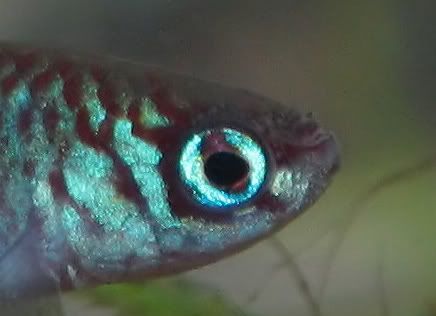
close-up of male head, the lower lips seem rather short compared with Au's L. fractifasciatus.
the unwilling and uncooperative female…
[Mod's Note]: Title edited June 28 2005
why I don't do garden hybrids and aquarium strains: natural species is a history of Nature, while hybrids are just the whims of Man.
hexazona · crumenatum · Galleria Botanica
Choy, The fish seems a little broken & stressed. Have not recover from the journey yet. Can you show Au's fish so as to see the difference?
here's Au's L. fractifasciatus Barra de Maricá

why I don't do garden hybrids and aquarium strains: natural species is a history of Nature, while hybrids are just the whims of Man.
hexazona · crumenatum · Galleria Botanica
Hi fellows
Leptolebias is an interesting genus, because it's a lot of different name used.
I think it's difficult to identify the different between fractifasciatus and minimus. In my opinion they look like very much like.
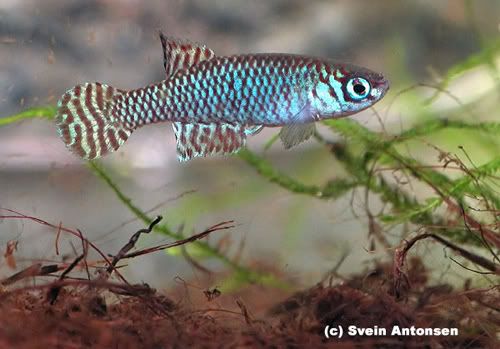
I have Leptolebias minimus (fractifasciatus) "Inoa" and it's funny that the species changes coloring from blue to red.
Do the Lep.fractifasciatus Barra de Maricà just have the red color?
Here is picture from Lep minimus (fractifasciatus) "Inoa"
Regards
Svein
My website:
http://home.c2i.net/svein_antonsen/index.htm

The proper ID should be Leptolebias fractifasciatus, instead of minimus.
The location Saquarema, falls within the distribution range of L. fractifasciatus, which is to the east of the bay/lagoon in Rio de Janeiro. This area also includes the populations from Barra de Maricá and Inoã.
L. minimus is located to the west of this bay/lagoon. Both species are separated by a mountain range in the middle.
Refer to the census for the necessary data.
The fish that Gan passed you are of the F4 generation as per info from the breeder who sent them here.
The fish from Barra de Maricá should have some blue iridescence on the body as seen in Svein's images of his fish from Inoã. I have observed this bluish iridescence in the fish from Saquarema as well, in the brief time that I had them.
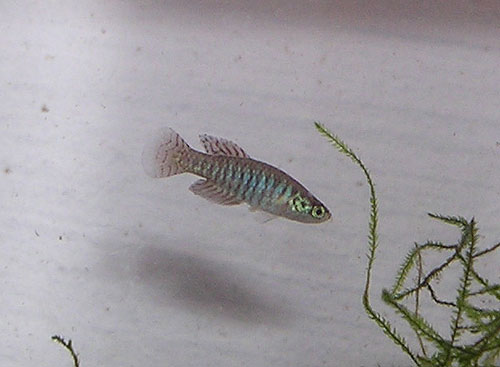
Image of a juvenile male fractifasciatus from the Saquarema population that was in my care for a few weeks. Sadly its no longer alive.
This is of the F5 generation.
Pardon the image quality but this was not touched up in anyway except for a resize.
Notice the blue on the flanks and the iridescence on the gill area.
Fish.. Simply Irresistable
Back to Killies... slowly.
Hi Svein, according to Costa, fractifasciatus has broken bars in the tail and minimus has uniform bars in the tail. Both species have a slight difference in terms of colour and also pattern.Originally Posted by Svein
They are also separated geographically and are considered distinct from each other as per the info given by some Brazilian hobbyists on the SAA mailing list.
Fish.. Simply Irresistable
Back to Killies... slowly.
Hi Jianyang
Thank's for your answer, and we have the normally problem Costa versus Dr. Jean Huber
According dr. Huber Lep. fractifasciatus is not a valid species, the correct species is minimus, but we probalbly have to wait till they find a solution
Anyway, if you look on the tails from the picture I think there are some different marks both broken and uniform.
Anyway, have you seen a picture from a Lep. minimus, if you have it should be very interesting to study it.
About the red and blue color, I think it depends what kind of light you have.
Regards
Svein
My website:
http://home.c2i.net/svein_antonsen/index.htm
That's correct. Its always Costa vs Huber.
If the Brazilians consider them to be distinct, and especially if they are those who have collected both species in the wild, then I suppose we should listen to them instead.
Yes there have been notes and info even in Costa's Cynolebiatinae book that there are intermediate specimens in both species and that is why Costa himself synonymised fractifasciatus with minimus for some time before he decided to revalidate fractifasciatus again.
I've seen images of Leptolebias minimus from the populations that fall into its geographic distribution area, namely those from Seropedica and Itaguai but I can't post it here as the images belong to other people.
If you want to I could e-mail you a map of the distribution of the Leptolebias species in the vicinity of Rio de Janeiro itself that I created on my own using a base map from multimap.com.
The blue colouration is apparent in most lighting as per my own observation, however it can disappear if the fish is flashed at directly during photography. At a certain angle however the blue colouration is quite apparent. Of course in a slightly yellowish light like incandescent lamps, the red is more apparent.
Fish.. Simply Irresistable
Back to Killies... slowly.
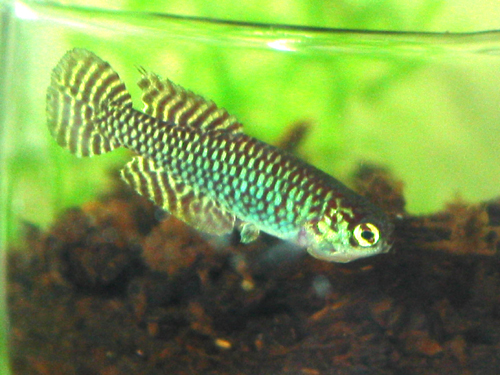
Here's the fish picture I took sometime back
Lighting was from the top so you get more blue.
my lighting is from the top too. Gan, I think your pix has green cast rather than blue on the fish.
why I don't do garden hybrids and aquarium strains: natural species is a history of Nature, while hybrids are just the whims of Man.
hexazona · crumenatum · Galleria Botanica
Its either green or blue, depending on how one sees it. Either way the iridescence is always there.
Fish.. Simply Irresistable
Back to Killies... slowly.
the green cast makes the red looks brown and the irridescent more obvious. my problem is that under flash this fish looks more red and less blue.
why I don't do garden hybrids and aquarium strains: natural species is a history of Nature, while hybrids are just the whims of Man.
hexazona · crumenatum · Galleria Botanica
In the pix, it seems to have yellow tail. This guy is like compare to a humming bird! Different colour at different angle.
Gan, you mean your pix? your pix has a strong green cast lah.
green+blue = yellow

why I don't do garden hybrids and aquarium strains: natural species is a history of Nature, while hybrids are just the whims of Man.
hexazona · crumenatum · Galleria Botanica
 Posting Permissions



Bookmarks