


 Reply With Quote

sadly, no. by the way, if ph is 7+, will it be ok? or must it be 8 and above?





 Never create what you can't control




That sounds like a lot of fun. Managed to see the live birth process?

sadly, no. by the way, if ph is 7+, will it be ok? or must it be 8 and above?
Never create what you can't control
Regarding the pH, I don't really know for sure. However, most literature would point to pH of high 7's to low 8's as the reading of the lakes.
I would recommend to replicate these for the fauna to thrive, but it is eventually up to you to try. However, if the parameters do not fall within the comfort zone, then they may not thrive and eventually, there could be health issues and so on. Personally, I would not go any lower than pH 7.5, but that's just me.
Never create what you can't control
For those curious about the reproduction of Tylomelenia, here's some information.
Tylomelania are viviparous[1] freshwater gastropods, where the embryo develops inside the body of the mother (as opposed to outside in an egg) and the mother then gives live birth. However, the strategy adopted by Tylomelania is the less developed form of vivipary called ovoviviparity[2], where unlike the embryos of viviparous species, ovoviviparous embryos are nourished by the egg yolk rather than by the mother's body.
For those interested in the technical details, you can read this scientific paper done by Dr. Thomas von Rintelen and Dr. Matthias Glaubrecht.
von Rintelen, T. & Glaubrecht, M. 2005. Anatomy of an adaptive radiation: a unique reproductive strategy in the endemic freshwater gastropod Tylomelania (Cerithioidea: Pachychilidae) on Sulawesi, Indonesia, and its biogeographic implications. Biological Journal of the Linnean Society, 85: 513-542.
Parts of the abstract,
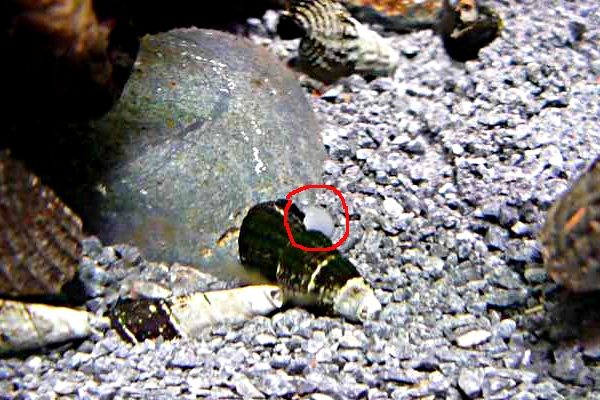
Well, for those less interested, there used to be a video showing the live-birth process, but apparently has been removed by the owner (www.water-box.de). Such a shame, all I can offer now is a terrible picture, at the start of the process.The most conspicuous feature of Tylomelania is its uterine brooding strategy, i.e. retaining eggs and embryos in the pallial oviduct. This is unique among South-East Asian pachychilids. Within the uterine brood pouch the offspring is surrounded by considerable amounts of nutritive material produced by a very large albumin gland, and the embryos are produced continuously. The shelled juveniles of some species are the largest known so far in viviparous gastropods, measuring almost 2 cm in length when hatching. This combination of reproductive features in Tylomelania, characterized by a high amount of maternal investment, is considered to be ovoviviparous, rendering its brooding strategy unique also among other gastropods.
The baby snail, which is very much alive, is in the white blob circled in red. The white blob is the nutritive material covering the baby snail, slowly dissolving in the water and finally, out pops the baby snail.
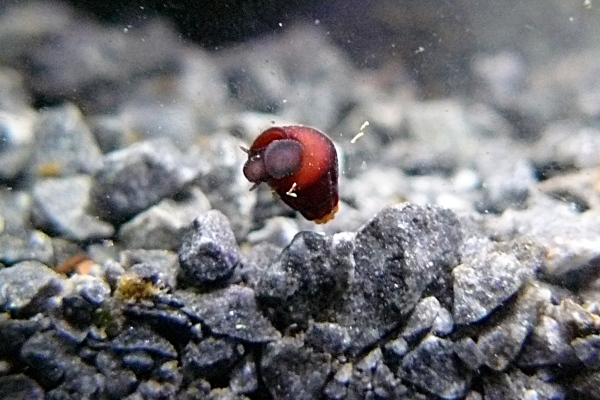
One of the baby Tylomelania.
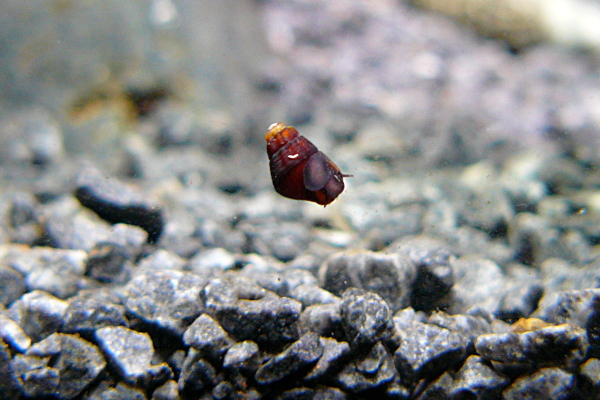
A different baby.
Same one, different orientation
[1] See Wikipedia, Vivipary, http://en.wikipedia.org/wiki/Vivipary (as of Aug. 7, 2008, 17:08 GMT).
[2] See Wikipedia, Ovoviviparity, http://en.wikipedia.org/wiki/Ovoviviparity (as of Aug. 7, 2008, 17:17 GMT).
Never create what you can't control
von Rintelen, T. & Glaubrecht, M. 2008. Three new species of the freshwater snail genus Tylomelania (Caenogastropoda: Pachychilidae) from the Malili lake system, Sulawesi, Indonesia. Zootaxa, 1852: 37-49.
New Tylomelania snails described. One of these, Tylomelania sinabartfeldi, has shell that is conic or subglobose[1], unlike the normal Tylomelania species we have seen.
[1] Subglobose: "Sub-" meaning partly, somewhat + "Globose" meaning ball-shaped
sulawesi snails are not easy, now there is another problem!
my sulawesi snails' shells are deterioting, the top part of the shell is dissolved. i thought that the ph was too low so i crushed some shells and put the pieces in the tank. however, their shell condition have not improved yet.
i finally got a ph indicator today and i was shocked. the ph was 9!!! if the ph is 9, why are my snail's shells still deterioting???
Never create what you can't control
The shells normally deteriorate from the top. If I remember correctly, this is something that was mentioned as an observation by the scientists in links to one of the scientific papers from my previous posts.
My impression and take is that it is somewhat "normal" and if there is no serious deterioration, then I wouldn't put it down as a cause for concern.
I don't seem to remember any hypothesis or reasons given for the observation. I'll post the exact quotes if I can find time to search for them.
thanks quixotic. your valuable advice over the past few mth have helped me a lot.
I have a question. since sulawesi fauna are suppose to thrive in higher PH water, are there any other snails other then helena that can survive in water with such PH? i tried putting ramhorns in my sulawesi tank, initially they were ok. but very soon all were wiped out by unknowwn reason. the shrimps and crabs are doing well inside though. i tried putting in another batch and the same thing happen.
They look like "Anentome Helena", do they eat up other kind of snails like Malayan Trumpet, Ramhorn?. People use it to clear up Malayan Trumpet snails etc.
Last edited by windcharm; 12th Sep 2008 at 10:29.
Never create what you can't control
The scientific paper is from post #9. Descriptions for a lot of the species (seems to me, it could be all of them) in the paper contain the following comment (do a search using the keyword "corroded").Originally Posted by lucasjiang

As such, it seems to be a norm, so I wouldn't be too worried about that (in my personal opinion of course)....top whorls in adult specimens always corroded to a varying degree...
In any case, snails generally don't do too well if the pH is too low, their shells may get corroded. What is the reading of your pH?
If it is anywhere around pH 7+, I think most other snails (pond, Malayan trumpet, nerite, even ramshorn) should be able to adapt to it. In your case, I think there are other factors that may be an issue. Do take note that crabs are scavengers, some are known to eat snails.
If it is anything above pH 8, not too sure on the above snails, but I think apple snails would do well. The only concern on apple snails is that they seem to have a tendency to escape from the tank, mileage may vary though.
A. helena is the only known predatory snail in the market. Tylomelania spp. will eat detritus, algae, decomposing matters and any food you feed.
my ph reading is around 7 to 7.5. that environment is created to suite sulawesi fauna. i just got a sulawesi snail and so far it is doing fine. if high ph is not a problem for snails i guess there should be some other reason. thanks.
Sorry for asking a noob question, are the snails asexual or is there a requirement for males and females to be present for reproducing?
i think a male and female is needed for reproduction. by the way, just upgraded mine to a 2 ft tank.
then how do we identify whether the snail is male or female?
Never create what you can't control
See post #24. The scientific paper as provided in the link mentioned that females are often larger than males (page 22).
I know it can be very daunting and difficult, especially those not technically inclined (like myself), to read scientific papers, but it can be rewarding, as answers to questions like these can sometimes be found.
However, take note that this is not an absolute certainty, or cast in stone. There exist some difficulties because they don't show much sexual dimorphism.
Also the lakes have many many different Tylomelania species, shapes and sizes where one species can look similar to another species. You may be hard pressed to tell if they are the same species, more so when all of them are mixed together in the same tank in the LFS, regardless of origin (different lakes).
Lastly, juvenile snails may be mistaken as the incorrect gender because they have yet to grow to the full potential size.
Hi Quix, could you share what type of substrate you're using and how you are keeping the pH high? I'm very interested to start a tank for these snails.
Never create what you can't control
I am using Seachem Onyx Sand, which buffers the water slightly above pH 7.0. If I remember correctly, it's about pH 7.4 in my case. Additionally using coral chips in one the compartments of the HOB filter, to buffer the water up to pH >8.0 (can't remember exact reading).
High pH of 8.0 or thereabouts seems to be ideal, but if you are able to buffer the water to around pH +-7.5, I suspect that they may be able to adapt to such conditions as I find them quite hardy.
Otherwise, if you are aiming for pH +-8.0, I think you can try using coral sand (or something similar). Then additional usage of coral chips may not be necessary as that desirable pH can be achieved just by using coral sand, somewhat similar to the African Rift Lakes setup.
 Posting Permissions



Bookmarks